An emergency plan is a short conversation that saves a lot of confusion later. It helps everyone in a household know what to do if something goes wrong, even if you are not all in the same place when it happens. You can make a useful plan in a single evening and improve it as you go.
Ready.gov, the U.S. government’s preparedness site, recommends that households make a plan for how they will receive alerts, where they will shelter, how they will evacuate, how they will contact one another, and whether their emergency kit needs an update. The notes below follow that outline in plain language.
Agree the basics together
- Two ways out of each room where possible, and a meeting point outside the home that is familiar and easy to find, such as a particular tree, mailbox, or neighbor’s front step. Agree a second meeting point a little further away in case you cannot return to the street.
- Who to call: write down a few important numbers on paper, in case phones are lost or flat. Include 911, a relative or friend out of the area, work and school contacts, and medical or veterinary numbers you would need in a hurry.
- Who helps whom: children, older relatives, and pets each need someone responsible for them. If anyone would need extra time or equipment to leave, say so clearly and build that into the plan.
- How you will get warnings: agree which official alerts you will rely on, such as a weather or emergency radio, a local warning system, or a phone alert, and who is responsible for paying attention to them.
- Where you would go if you had to leave the home for the night, and the route you would take. Have more than one route in mind in case a road is closed.
Ready.gov also asks households to think about everyday needs that would still matter in an emergency: ages of the people in the home, medicines and medical equipment, disabilities or other access needs, languages, dietary requirements, pets or service animals, and the places you go regularly, such as school or work. Write those details on the plan so you are not inventing them under stress.
Put the written plan where people can find it, and give a copy to someone outside the home. You do not need a long document. A single page with names, numbers, meeting points, and medical notes is enough to start.

Prepare a small kit
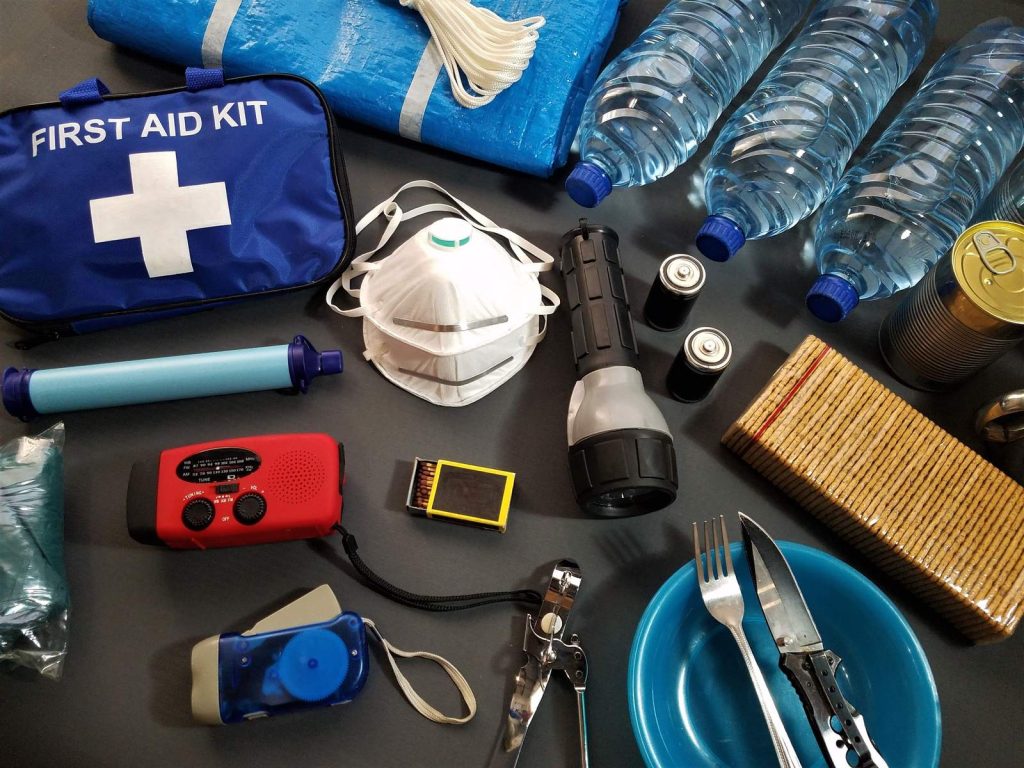
Keep a few essentials together in a bag or a lidded box that you can pick up quickly. Ready.gov’s build a kit guidance says that after an emergency you may need to get by on your own for several days, and it lists a basic set of supplies. A household kit can include:
- Water — Ready.gov recommends one gallon per person per day for several days, for drinking and sanitation — and a several-day supply of non-perishable food, plus a manual can opener.
- A flashlight, extra batteries, and a battery-powered or hand-crank radio.
- A basic first-aid kit, any regular medicines, and copies of prescriptions if you have them.
- A phone charger or power bank, and a spare charging cable.
- Copies of important documents (identification, insurance, bank details) in a waterproof pouch, or stored securely online.
- A whistle, a dust mask, moist towelettes and bags for sanitation, and a wrench or pliers to turn off utilities if you have been shown how to do so.
- Supplies that match your household: infant formula and diapers, pet food and extra water, eyeglasses, or other items you would not want to leave behind.
You do not have to buy everything at once. Start with what you already have, then add to the kit over time. Keep it in a place everyone knows, check dates once a year, and replace anything that has expired. Ready.gov also suggests thinking about a smaller “go” kit for work or the car, in case you are not at home when you need supplies.
Check the safety equipment
Working smoke alarms are one of the simplest protections you can put in place. The U.S. Fire Administration recommends smoke alarms inside and outside each bedroom or sleeping area, and on every level of the home, including the basement. Choose interconnected alarms so that when one sounds, they all sound, if you can.
- Test smoke alarms every month. Replace 9-volt batteries at least once a year, or replace the unit when the manufacturer says the long-life battery is finished.
- Replace the entire alarm about every 10 years, or as the manufacturer directs. The date of manufacture is usually on the back of the unit.
- Never take the battery out to stop an alarm while you are cooking. Open a window, use the “hush” button if there is one, or fan the air clear. A disabled alarm cannot warn you later.
- Know where the fire extinguisher or fire blanket is, if you have one, and how to use it. Fire extinguishers are for a small, contained fire; if a fire is spreading, leave and call 911.
If anyone in the home would not hear a standard alarm, ask your fire department about alarms with a strobe light or a bed shaker. Some fire departments will help with battery-operated alarms or a home visit. Use their non-emergency number to ask.
Practice once
Walking through the plan once makes it far more likely that people will remember it. Try a simple fire drill: everyone leaves by their planned route and meets at the outside meeting point. Do the same in your mind for a power cut or a night when you might have to stay inside. Review the plan whenever someone moves in or out, when you move home, or when medical needs change.
Show everyone how to unlock doors in the dark, how to open a window that is part of an escape route, and where the kit and the shut-offs are. If you have children, practice without turning it into a scare. A short, calm rehearsal is enough.
Local authorities and emergency services often publish preparedness advice for the hazards in your area — floods, wildfires, winter storms, or power cuts, among others. It is worth reading the guidance that applies to you and adding two or three local details to your page of notes. If you are in immediate danger, call 911 first. Our emergency page lists simple next steps.
iDefenses provides general information only. It is not a law firm and does not give legal advice. Reading this site does not create a lawyer–client relationship.
Conversation
0 comments